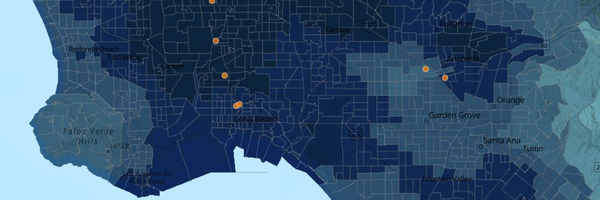
Air Quality: PM2.5
Exposure Indicator
Measures fine particle pollution in the air—tiny particles that lodge deep in the lungs and contribute to heart and lung disease across California.
What is PM2.5?
Particulate matter, or PM2.5, is very small particles in air that are 2.5 micrometers (about 1 ten-thousandth of an inch) or less in diameter. This is less than the thickness of a human hair. Particulate matter, one of six U.S. EPA criteria air pollutants, is a mixture that can include organic chemicals, dust, soot, and metals. These particles can come from cars and trucks, factories, wood burning, and other activities.
Why is it included in CalEnviroScreen?
- The smaller the particles, the deeper they can move into the lungs when we breathe.
- Fine particle pollution has been shown to cause many serious health effects, including heart and lung disease.
- Exposure to PM2.5 contributes to deaths across California.
- Children, the elderly, and people suffering from heart or lung disease, asthma, or chronic illness are most sensitive to the effects of PM2.5 exposure.
How is it measured?
- The California Air Resources Board measures PM2.5 concentrations from a wide network of air monitoring stations across the state.
- The indicator combines PM2.5 concentrations from monitors along with satellite observations estimated at a 1 kilometer grid.
- Days where wildfire smoke was detected by satellite anywhere in the state were identified and excluded from the analysis. This was done to represent a stable distribution of statewide PM2.5 concentrations.
- Annual means were computed for each year from 2022–2024 by averaging daily estimates to annual estimates, then averaging across the three-year period.
- Census tract PM2.5 estimates were calculated by averaging the grid cell estimates within each census tract boundary.