
State Launches a New Feature to CalHeatScore to Make Extreme Heat Info Accessible to More Californians
CalHeatScore API allows integration of CalHeatScore data into a variety of applications.
For Immediate Release
Contact: Amy Gilson, (916) 764-0955
SACRAMENTO – With summer around the corner and in the wake of a record-setting March 2026 heatwave, California is announcing a new feature to integrate California Communities Extreme Heat Scoring System (CalHeatScore) data into a wide range of applications to help Californians stay safer during extreme heat.
CalHeatScore, released last year, is a cutting-edge tool to forecast and rank the risk hot weather poses to public health and connect Californians with available resources to stay safe during extreme heat events.
The new CalHeatScore application programming interface (API) gives app developers, weather services, local governments, nonprofits, universities, medical providers, emergency response entities, and data-driven reporters access to live data that can be integrated into a wide range of applications, such as community alerts, emergency response planning, and newscasts.
“With summer-like temperatures arriving in California in March, tools such as CalHeatScore and its API are more critical than ever,” said OEHHA Director Kris Thayer. “Extreme heat is dangerous, and we are continually strengthening CalHeatScore to inform actions that protect residents from the impacts of extreme heat and build resilience in our most vulnerable communities.”
Use of CalHeatScore
The new CalHeatScore tool is already being leveraged to provide early warning to enable resources to be mobilized with greater speed and precision to communities that need it:
- As California prepares to host World Cup events this summer, the California Department of Public Health has integrated CalHeatScore data into preparedness reports to support the safety of attendees, workers, and local communities.
- The California Office of Emergency Services is now pulling live CalHeatScore data via the API into its statewide operational dashboard to support the state’s ability to monitor and respond to potential heat events that impact public health.
- To connect high-risk patients with community resources and recommendations ahead of dangerous weather, doctors at the University of California at San Francisco are incorporating CalHeatScore data into an electronic health record-integrated pilot tool that will enable doctors to identify patients who are the most vulnerable to extreme heat’s health impacts and create real-time, personalized, and automated messaging to support their health and safety during extreme heat events.
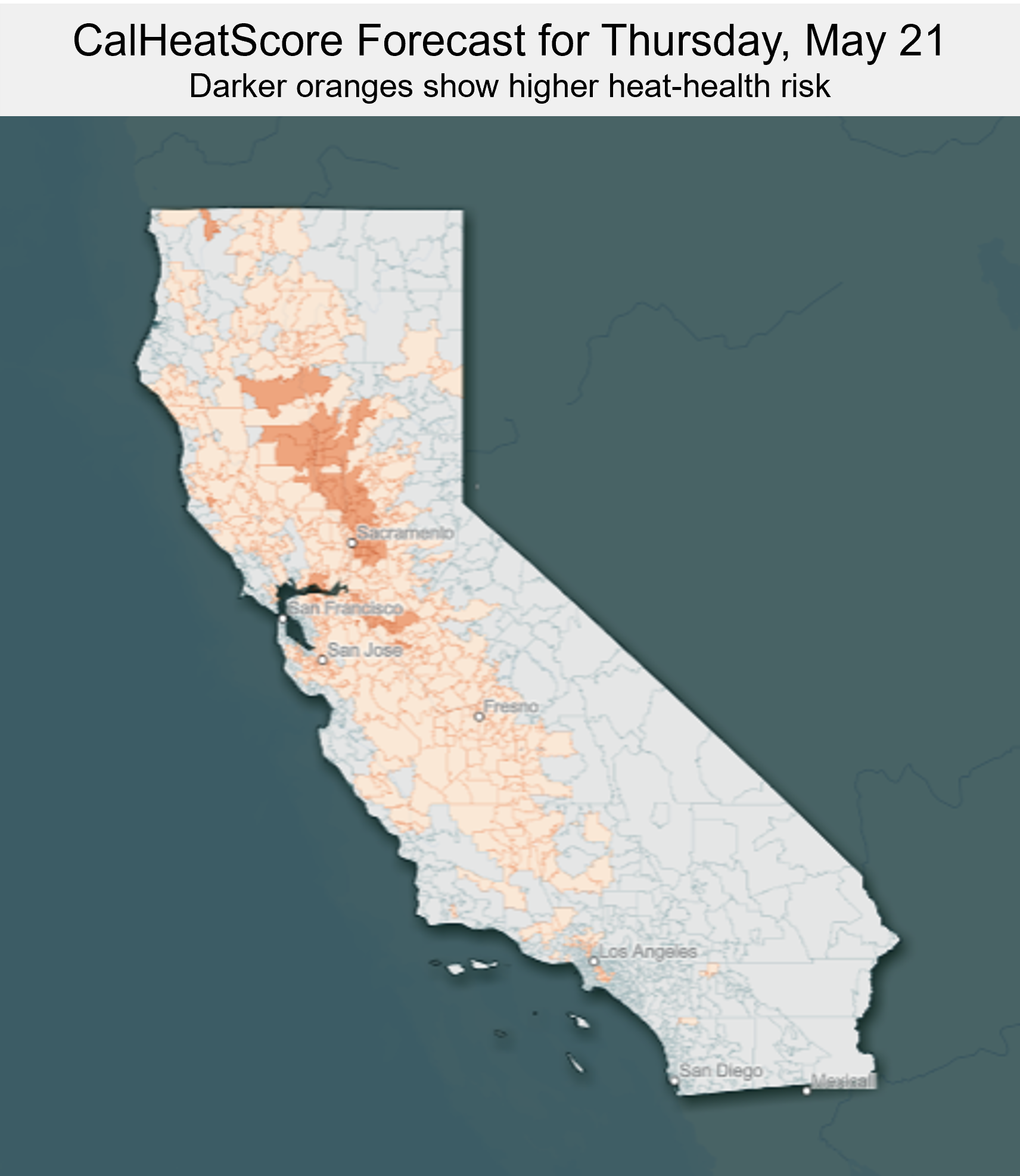
- California investor-owned utilities have proposed using CalHeatScore in power shutoff policies to support more localized decision-making during heat events. With live data, CalHeatScore can help ensure that protective actions happen exactly when and where they’re needed.
About CalHeatScore
In a hotter, drier world, connecting Californians with extreme weather information and resources has never been more important.
In 2025, California became the first state in the nation — and one of the only jurisdictions in the world — to launch a heat-ranking system.
CalHeatScore, developed by the California Environmental Protection Agency’s Office of Environmental Health Hazard Assessment (OEHHA), brings together ZIP-code level data to provide locally tailored heat scores.
It translates complex weather and health data into clear guidance and integrates other important data sets, like locations for the nearest cooling centers.
CalHeatScore also provides local data on groups susceptible to extreme heat, such as older adults and children, to support community planning efforts and provides tips for staying safe, such as how to recognize signs of heat illness.
The API is part of continuous efforts to develop, improve and broaden options for using CalHeatScore and keep Californians informed about extreme heat in their communities.
Dangers of Extreme Heat
CalHeatScore Value and Impact Level Expanded
| CalHeatScore (CHS) Value | Impact Level | Meaning* In your zip code… |
|---|---|---|
| CHS 0 | Low | Little to no heat-related health impacts are expected. |
| CHS 1 | Mild | Warm day. A minor increase in heat-related health impacts is expected among those sensitive to heat. |
| CHS 2 | Moderate | Very warm day. A moderate increase in heat-related health impacts is expected among those sensitive to heat. |
| CHS 3 | High | Hot day. An increase in heat-related health impacts is expected for everyone, especially those without access to adequate cooling and hydration or those engaged in strenuous physical activity outdoors. This level of heat can pose a significant risk to health. |
| CHS 4 | Severe | Extreme heat day. A major increase in heat-related health impacts is expected for everyone, especially those without access to adequate cooling and hydration or those engaged in strenuous physical activity outdoors. This level of heat can pose a very serious risk to health. |
In 2024, California communities experienced the hottest summer on record in 130 years. According to a report from the Department of Insurance, from 2013 to 2022, seven extreme heat events resulted in nearly 460 deaths, over 5,000 hospitalizations and about 344 adverse birth outcomes.
State reports show a correlation between heat and a range of negative health effects including death, lower birth weight, and increased emergency room visits and hospitalizations for conditions ranging from heart conditions to poor mental health.
Extreme heat also takes an economic toll on the state, with an estimated $7.7 billion of lost wages, agricultural disruptions, and power outages from 2013–2022.
State Response
With ongoing work on CalHeatScore, an update to California’s Extreme Heat Action Plan moving forward, and a new round of the Extreme Heat and Community Resilience Program (EHCRP) from the Governor’s Office of Land Use and Climate Innovation underway, California continues to prioritize building resilience and climate action to protect communities.
In addition to CalHeatScore, Californians can learn more about actions they can take to protect themselves and others during extreme heat through Listos California and the California Department of Public Health.
About OEHHA
The California Office of Environmental Health Hazard Assessment (OEHHA) is the lead state agency for the assessment of health risks posed by environmental contaminants.
OEHHA’s mission is to protect and enhance the health of Californians and our state’s environment through scientific evaluations that inform, support and guide regulatory and other actions.
As CalEPA’s scientific adviser, OEHHA works within CalEPA and across state government, with other state and federal agencies, businesses, community-based organizations, and Native American Tribes across California to develop actionable science that protects public health.
In addition to assessing health risks posed by chemicals, OEHHA develops data tools that support environmental health, performs outreach and education about pesticides and other chemicals, surveys exposure to harmful chemicals through Biomonitoring California, and assists in emergency response through expert consultation on matters related to chemical exposures.
More information about OEHHA can be found on the official website.
###