
Program Goals
OEHHA is exploring and evaluating the applicability of NAMs for specific purposes, e.g., chemical prioritization for risk assessment, chemical grouping and read-across, and development of predictive approaches for chemicals lacking traditional toxicity data. For wider acceptance of NAMs, it is imperative that these efforts use rigorous scientific analysis, transparency, stakeholder and community engagement, and effective communication. OEHHA created NTES in 2023 to facilitate the development, evaluation and adaptation of NAMs for potential regulatory and non-regulatory applications with a focus on validation, applicability and characterization of uncertainty of these methods.
The goals of the program are to:
- Integrate NAMs with traditional toxicity data to facilitate risk assessments of unassessed chemicals.
- Implement NAMs to develop hazard assessments and health guidance values for chemicals lacking assessments, including emerging chemicals and chemical groups of concern.
- Build and maintain chemical data repositories and biologically based models to support regulatory decision-making.
- Collaborate with academic and government partners to develop, evaluation, and refine NAMs tools.
- Publish peer-reviewed research and technical reports to advance NAMs in chemical risk assessment.
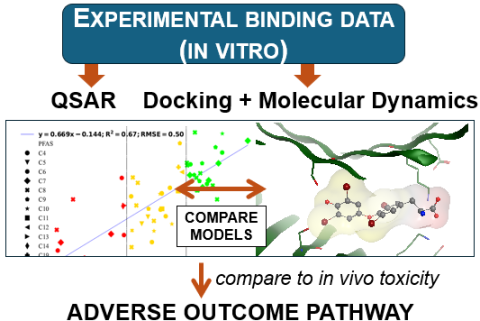
The image above illustrates a recent NAMs project at OEHHA. Different types of models (QSAR, docking, molecular dynamics) were developed based on experimental in vitro binding data of the chemical of interest to the molecular target responsible for toxicity. The resulting models were compared among each other (to improve interpretation and performance). The binding predications were correlated with observed in vivo toxicity for those chemicals that have the data. Altogether, this analysis informed an adverse outcome pathway for the chemicals and toxicity of interest and allowed the development of predictive models in this framework.