Process and Timeline for Fisheries Closure after an Oil Spill
California Fish and Game Code 5654 establishes the initial timeline for a fisheries closure action after an oil spill notification is received. This process and timeline have been revised to reflect updates to Fish and Game Code 5654 as of January 1, 2026 (Senate Bill 839).
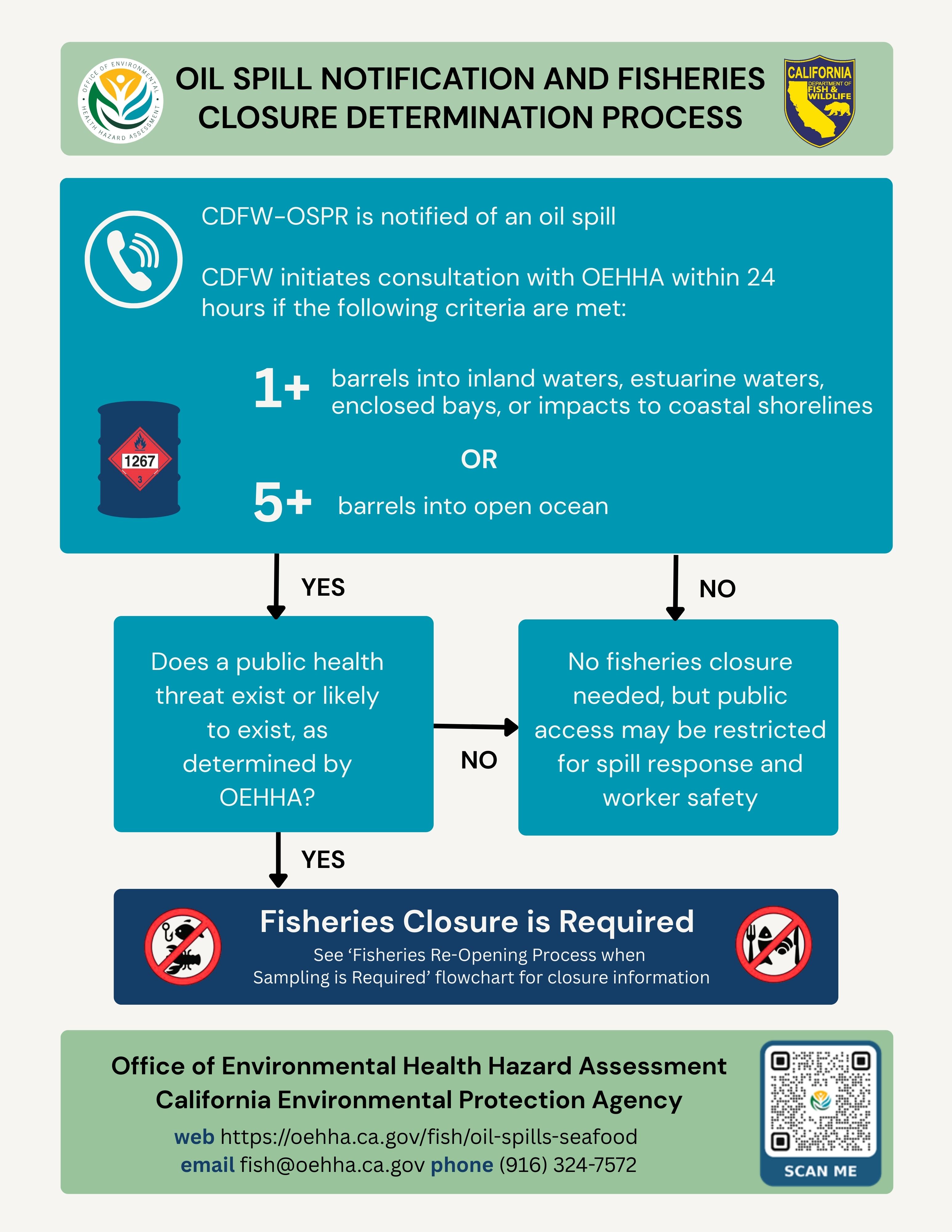
- Within 24 hours after spill notification, CDFW shall initiate consultation with OEHHA if the following criteria are met (Fish and Game Code 5654):
- Reported volume of 1 or more barrels of oil into inland waters, estuarine waters, enclosed bays, or impacting coastal shorelines
- Reported volume of 5 or more barrels of oil into open ocean waters
- A fisheries closure shall be required if OEHHA finds a public health threat exists or is likely to exist.
- Within 48 hours after an oil spill-related fisheries closure:
- OEHHA shall assess the danger to the public from fishing and consuming fish or shellfish in the area where the spill or discharge occurred or spread to, or that were contained in a potentially contaminated recirculating seawater tank.
- CDFW, in consultation with OEHHA, shall determine whether the fisheries closure areas should be revised.
Within 7 days after an oil spill-related fisheries closure: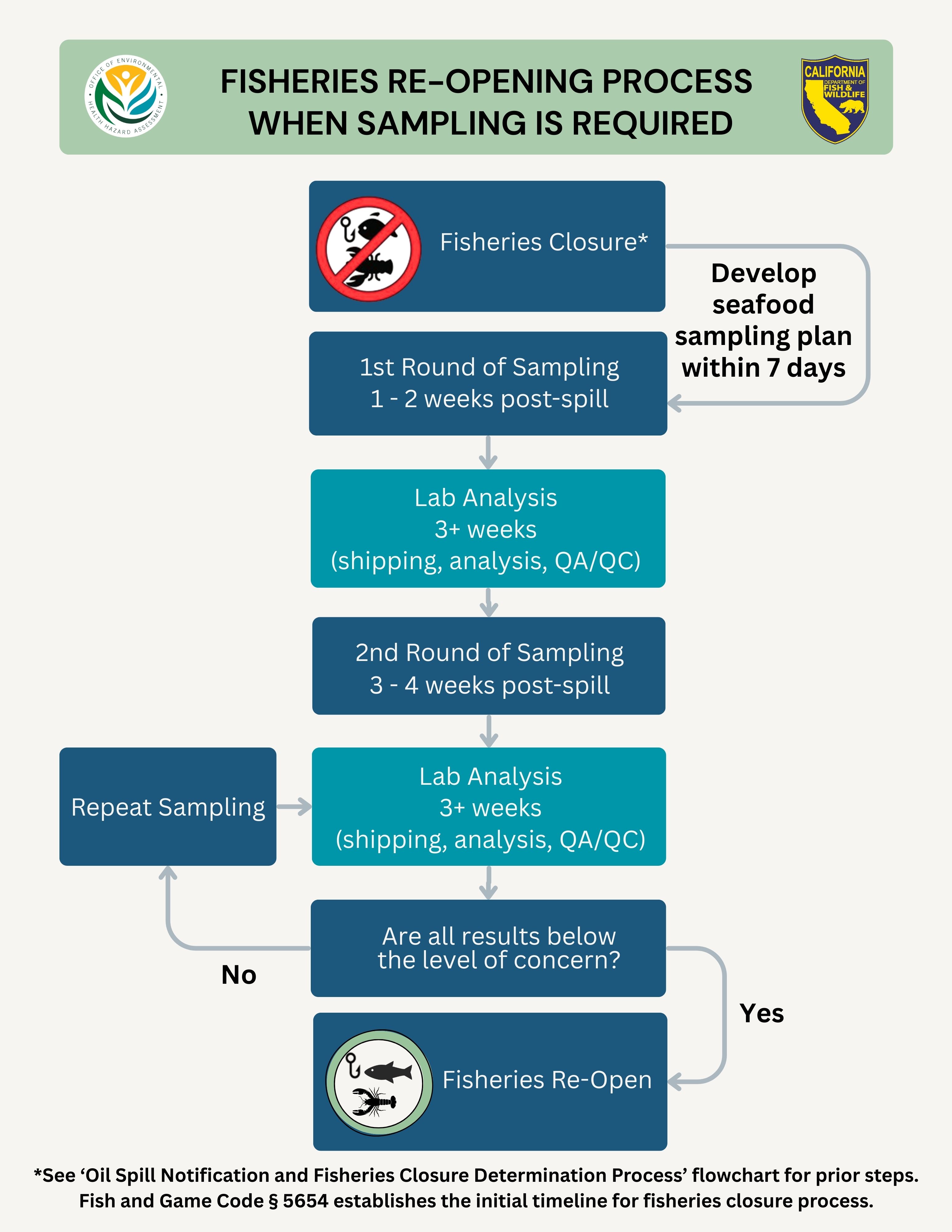
- CDFW can re-open a closed area without seafood testing if OEHHA finds there is no significant risk to the public, or
- If significant risk exists, rapid testing of seafood must be ordered to determine the levels of contamination, if any, and whether the fish or shellfish are safe for human consumption.
Following smaller spills, only shellfish such as bivalve mollusks may be tested because these species pose a greater risk of accumulating PAHs.
Following larger spills, finfish or other shellfish may be tested.
See our Oil Spills and Seafood Fact Sheet for details on seafood testing, laboratory analyses, and OEHHA’s risk evaluation.
See our updated flow charts (also shown to the right) for the initial consultation and fisheries closure determination process and re-opening when sampling is required.
Documents
Fish, Incident Response, Seafood Safety, and Harmful Algal Bloom Section
Sacramento Office
1001 I Street
Sacramento, CA 95814
Phone: (916) 324-7572
Fish@oehha.ca.gov