
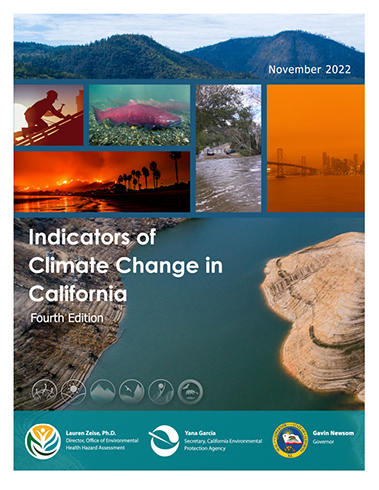
2022 Report: Indicators of Climate Change in California
The fourth edition of the report contains a new section highlighting how California Tribes have witnessed climate change. Eight Tribes provide accounts of their unique experiences. Information about OEHHA’s ongoing work with Tribes to document the impacts of climate change can be found here: Indicators of Climate Change: Impacts on California Tribes.
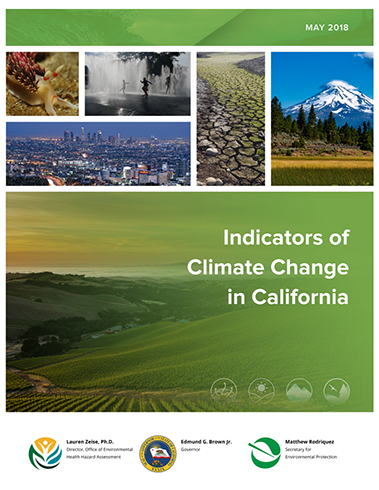
2018 Report: Indicators of Climate Change in California
The third edition of the report, published in 2018, presented 36 indicators grouped into four categories: human-influenced drivers of climate change, such as greenhouse gas emissions; changes in the state’s climate; impacts of climate change on physical systems, such as oceans and snowpack; and impacts of climate change on biological systems – humans, vegetation and wildlife.
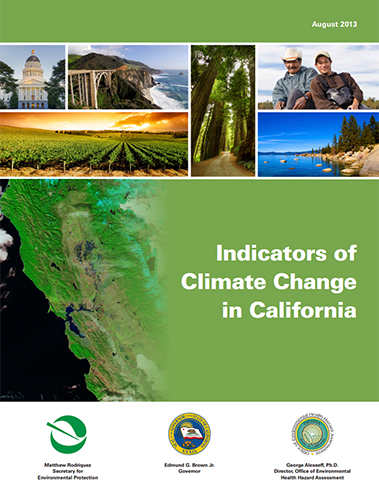
2013 Report: Indicators of Climate Change in California
"Indicators of Climate Change in California," a 2013 report presenting 36 indicators tracking trends in atmospheric gases that influence climate, changes in the state's climate, and the impacts of climate change on California's environment and people.
2010 Report: Indicators of Climate Change in California
In 2009, the California Environmental Protection Agency’s (Cal/EPA) Office of the Secretary requested the Office of Environmental Health Hazard Assessment (OEHHA) to develop indicators describing the disproportionate impacts of climate change on environmental justice communities. This report presents four indicators that help track trends relating to the disproportionate impacts of climate change on these communities.
2009 Report: Indicators of Climate Change in California
This 2009 report identifies 27 indicators that measure the impact of climate change on the state’s temperatures, precipitation, land, water, people, plants, and animals. It concludes that changes in California are consistent with those occurring globally. The report is a meta-analysis of existing research.